no middle ground
I’m feeling depressed, bored of all these details in a journey that has lost inspiration and shows no sign of changing soon.

Gavin and I have arranged to meet at noon today in Grand Baie, where we first met. I text him a confirmation in the morning, and let him know I’ll send him my Live Location once I leave the house. To ensure he knows what I mean, and hoping he’ll reciprocate, I punctuate this with a screen grab with the Live Location option circled in red. Once on the bus, I call him and say I may be 10 minutes late.
He tells me to relax, he isn’t expecting me at the stroke of noon. By “twelve” he meant maybe 12:00, maybe 12:20. I get it, Island Time; I remember it well from Hawaii, and this casual attitude I prefer to the tension Westerners have around time and punctuality.
I’m not entirely sure this is the same beach; Grand Baie has more than one. But in any case, he has my Live Location. This time I don’t let my glance linger as I feel the money-hungry gaze of the boat captains, food truck operators and other local people hanging around. I find one empty bench and text him: “Here I am. Maybe not the same bench, but the same beach, I think.”
Two different people in turn sit beside me over the next hour, their faces in their phones. I try to be productive on my own, but reception by the shore is terrible. The problem I was having the other day had nothing to do with any need for a VPN. Trying to use my phone as a hotspot here is useless; even browsing with it alone is tediously slow.
Finally Gavin calls me, asking me where I am. I tell him to look at the Live Location. He has no idea what I am talking about, and can’t understand how I could be anywhere but the exact same bench where we met the other week. The woman beside me starts chuckling as I repeat myself ever more slowly and with increasing exasperation. She intervenes and takes the phone from me. After finishing up the conversation for me, she tells me in English that many people in Mauritius have no idea how to read an online map, and that it’s best to use landmarks; she used the building across the street, which turns out to be a casino.
Gavin shows up and our mutual frustration vanishes. We chat easily. He thinks I’ll have no trouble getting my visa, regardless of what the official word on requirements may be. “You are an American, not…” he pauses.
“African?” I finish his thought. He smiles wryly. “Exactly.”
I tell him of my frustrations trying to find housing on Facebook and the real estate Web sites. I’m seeing shared homes for 15K rupees and higher, apartments over a very wide range starting from 20K. Ridiculous, he says, I have an entire house for only 10K.
It is only then that he mentions his own housing woe. Some time ago, he sold his house and became a renter. His pension is barely more than 20,000 rupees a month, and to make ends meet he asked his landlords to find him a roommate. So he is still paying nearly a quarter of his income on rent, and is very unhappy with his roommate.
He describes him as a Malagasy youth who never contributes to the house cleaning, drives up the electric bill by washing a few changes of clothes several times a week, and has never bought a thing for the house while making use of Gavin’s kitchen equipment. He almost never sees Gavin as he comes and goes to work, leaving Gavin feeling as if he shares his home with an indifferent stranger.
The young man was living with four other youth from Madagascar in another of the landlords’ properties, and Gavin thinks the others wanted rid of him. The landlords have not yet added his name to the lease; they are waiting to hear from Gavin if he is happy. He has been thinking of asking them to ask the man to move out, and suggests that I would make a much better roommate.
It would be only 5,000 rupees a month, but Gavin doesn’t think I should jump on it, since I could get a place of my own for not much more.
Well, that might be true, I say, but I’m not finding anything that cheap, not even a share. I do wonder whether living together would be a strain on our friendship, but I let him know I’d be interested. OK, he says, but I still need to talk to the landlords and they will have to give the boy 30 days’ notice. You should keep looking, you can’t keep living in a hotel and paying $20 USD a night. And he promises to ask around on my behalf.
I feel we have been sitting in one place too long and I owe him a coffee or something. He dismisses my suggestion, but I insist. Reluctantly he takes me up and finds us a cafe after a bit of wandering. Not hard to see why he is unfamiliar with the businesses here in these touristy quarters. Our coffees are predictably overpriced, and he is the only local customer in the place. I note with annoyance that the coffee is made from instant. This is the norm here; the 200-rupee bag of drip coffee I got at the supermarket would be fare for foreigners.
As I see him off, he asks with embarrassment if I could lend him 200 rupees until his next pension payment comes in. I think nothing of it, and while I wonder whether this is really a loan or a gift, I really don’t think he has an agenda in making my acquaintance.
Hanuman, proprietor of the hotel I’m moving to, texts me the number of a taxi driver and an estimate of how much he thinks he will want to move me from Pereybere. I’m busy, and let the message go unanswered. A bit later he sends a followup with a lower price. So, I have haggled the price down without making the slightest effort.
I’ve got the number of another taxi driver that, unsolicited, a cashier at the supermarket gave me some time ago. I send him a text. He wants the exact same amount, so I thank him and go with the one the hotelier recommends.
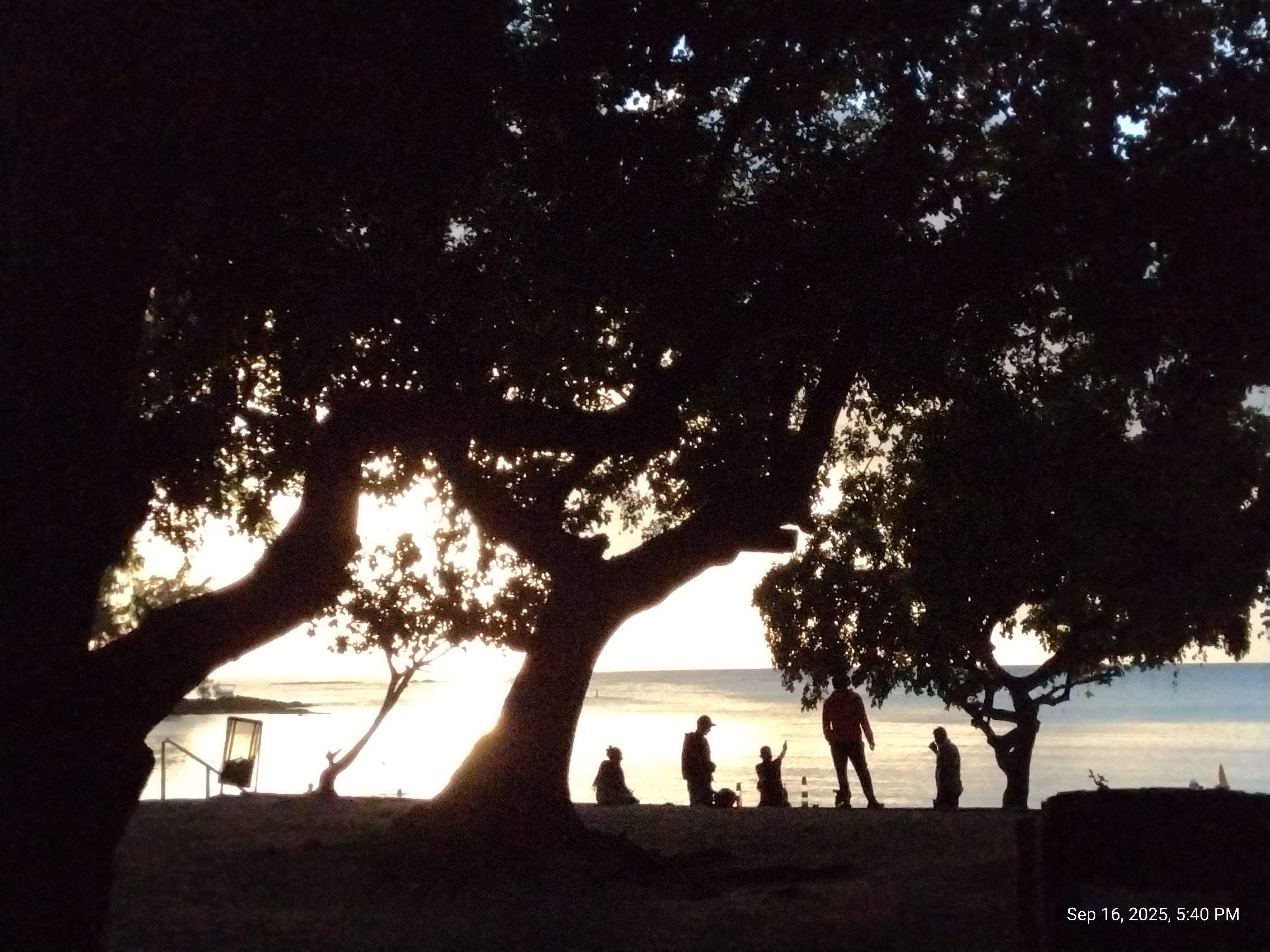
I’ve missed the sunset, an almost sacred ritual for me. I’m feeling depressed, bored of all these details in a journey that has lost inspiration and shows no sign of changing soon. I’ve avoided buying more groceries, I am not up to contriving a meal from the scraps I have, and I don’t know how I’m going to pack them; should have thought about that earlier.
So I return to my Mecca, the beach, and indulge in fried rice from the last food truck still open. No, they don’t happen to have any cardboard boxes, but maybe if I’m lucky, I can get some at the supermarket if they happen to be stocking when I get there.
As I wolf down my meal, a man approaches, gives me his business card and his sales pitch. He is a massage therapist; he works out of his home in Goodlands, but can do outcalls. “Nice work,” I say, “This is better than working at a spa or hotel. I’m also a massage therapist. Sit down, let’s talk shop.”
We trade numbers and I text him a link to my YouTube demonstration of my techniques. He suggests we do a trade some time at his home, and says he’ll cook me a vegetarian meal. I tell him I’ll be in touch after I’ve settled in some place, and ask him the same favor I ask everyone. Like everyone else, he promises to keep an eye out, then moves on to ply his trade to the last stragglers in the dusk.
As I leave the beach, I see him mounting his motorbike. Does he have a car? I wonder. If not, how does he transport his table for outcalls, hire a taxi every time?
I’m not worried whether anything will come of this latest exchange; sooner or later, things will work themselves out. The beach has worked its magic; if questions have not been answered, they have been unasked. Stripped of the burdens the mind places on it, life stands with its inherent beauty exposed.
I score some cardboard boxes at the supermarket and buy a roll of tape. One box is just to protect the weaver’s nest. I’ll be up late packing, but I feel merry about it. I note that my mood has swung all the way back to optimism. I know no middle ground between doom and the sense that nothing can go wrong, and it takes very little to trigger a swing from one extreme to the other.